
A three-foot putt should never feel like a decision. When it does, when the putter head twitches, jabs, or freezes over the ball on a putt you’ve made a thousand times, something has changed that has nothing to do with your stroke mechanics on the range. That change has a name, and it is treatable, but only if you know which kind you have.
What the yips actually are, and why they are not just nerves
The yips are an involuntary disruption in the fine motor control needed to execute a short putt. Researchers who study the condition describe it as a movement disorder, closer to a focal dystonia than to simple nervousness, that shows up specifically in trained, repetitive, small-muscle tasks. Putting qualifies. So does dart throwing, free throw shooting, and handwriting for people who do a lot of signing.
That distinction matters because it separates the yips from garden-variety pressure. Everyone feels their heart rate climb over a putt that matters. The yips are different: a golfer with a sound, repeatable stroke on the practice green can stand over the same putt on the course and watch their hands do something they did not intend. The wrists break early. The putter face shuts. The stroke that was smooth seconds ago in warm-up becomes a stab.
There are two distinct patterns hiding under that one word, and they do not respond to the same fixes. One is a technical breakdown: the stroke itself has drifted, and the twitch is the symptom of a mechanical fault that has been compensated for so long it now shows up as a jab. The other is anxiety-driven: the mechanics are fine in isolation, but the nervous system hijacks the stroke the moment the putt counts. Treating an anxiety yip with grip changes, or a technical fault with breathing exercises, wastes time you could spend fixing the actual problem.
The two-minute test: is this a technical yip or an anxiety yip
Before you touch your grip or your routine, run this test. It takes less time than reading about it.
Find a flat three-foot putt. Hit ten putts with no one watching, no scorecard, nothing on the line, and pay attention only to what the putter head does on the way back and through.
- If the stroke looks and feels rough even here, with a jerky takeaway, an early hit, or a face that twists through impact regardless of stakes, you are looking at a technical yip. The fault is present whether or not the putt matters.
- If those same ten putts look clean, smooth, and controlled, but the stroke falls apart the moment you add a consequence (a bet with a playing partner, a score you’re trying to protect, a gallery of one watching from the cart), you are looking at an anxiety yip. The mechanics are intact under low stakes and break down specifically under pressure.
A third pattern shows up for some golfers: the stroke is clean alone, breaks down with any audience at all, even a spouse watching from ten feet away, regardless of whether anything is at stake. That’s still an anxiety yip. The trigger is attention, not score.
Write down which one you saw. The rest of this article splits by that answer, and running drills for the wrong category is the single most common reason golfers say they’ve “tried everything” for the yips and nothing worked.
Grip and setup changes that interrupt the twitch
This section is for the technical yip, where the stroke itself has a mechanical fault. The fastest way to interrupt a learned twitch is to change the physical setup enough that the old movement pattern no longer fits the new grip. You’re not trying to find a “correct” grip here. You’re trying to break a motor habit by making the familiar version impossible to execute.
The claw grip. The lead hand holds the club conventionally, the trail hand sits lightly against the side of the grip rather than wrapped around it, fingers loose. This reduces the trail hand’s ability to flick or jab through impact, which is the single most common technical fault behind a short-putt twitch.
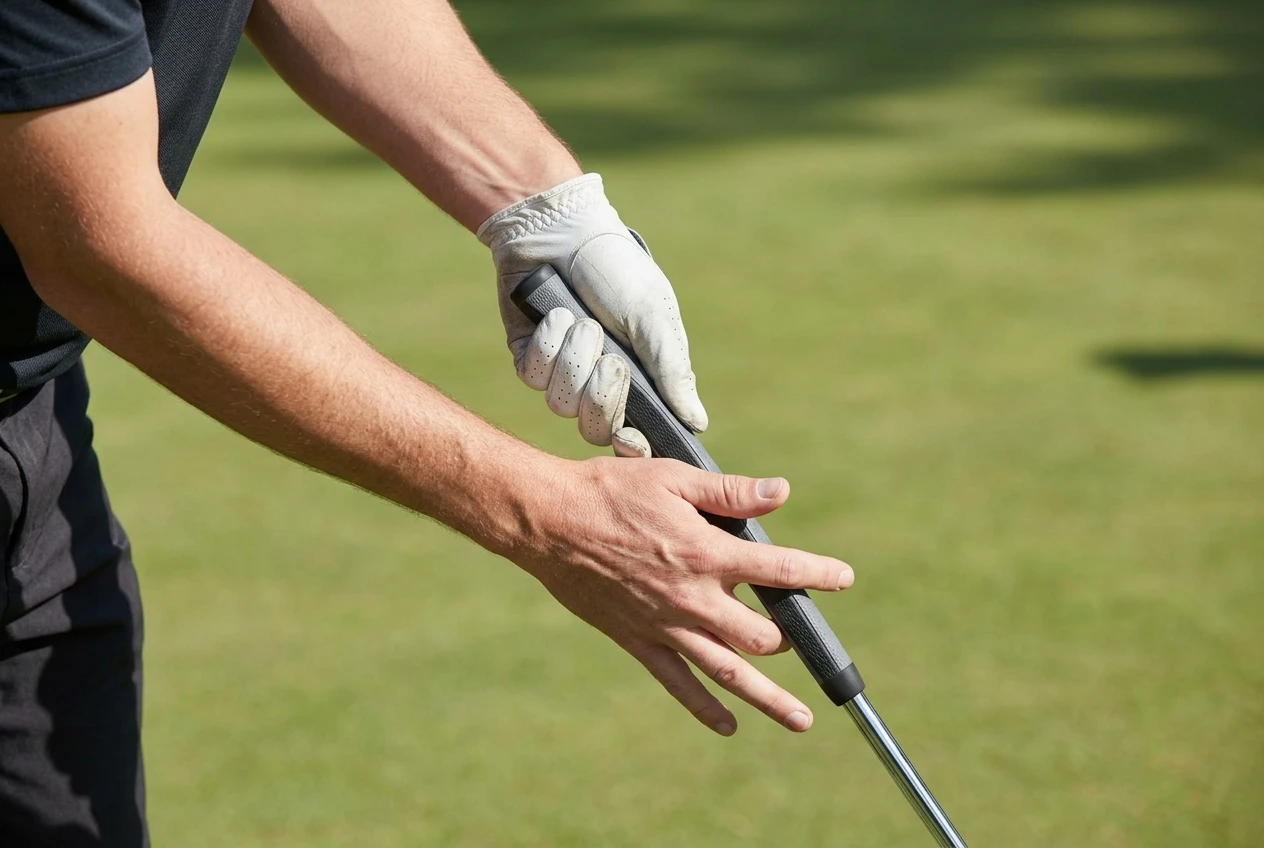
Cross-handed (lead hand low). Reversing the normal hand position so the lead hand sits below the trail hand on the grip tends to quiet wrist action on the lead side and keeps the shoulders more level through the stroke. Many golfers find the putter face stays squarer to the path with this grip simply because the old hand sequencing no longer applies.
Left-hand low for right-handed golfers (the same idea as cross-handed, described the other way) works for the same reason: it forces a new pattern, and new patterns don’t carry old twitches with them.
Try each for a short session rather than committing to one blind. The goal isn’t finding a permanent grip for the rest of your career, it’s finding the one that produces the cleanest stroke right now while the old pattern fades. You can always transition back toward a conventional grip later once the twitch is gone, the same way you’d retrain a stroke generally. For the underlying fundamentals a new grip should still respect, the piece on how to develop a consistent putting stroke covers what a repeatable stroke actually requires.
Drills that retrain the stroke without conscious control
Still addressing the technical yip. The problem with most putting practice is that it keeps the conscious mind fully engaged in steering the putter, which is exactly the circuit that’s misfiring. These drills work by removing that circuit from the task.
Eyes-closed putting. Set up to a three-foot putt, take one look at the hole, then close your eyes before you start the stroke and keep them closed through impact. Without visual feedback, you can’t consciously steer the putter, which forces the stroke to run on feel rather than correction mid-swing.
The brush drill. Make practice strokes brushing the grass without a ball, focusing purely on tempo, back and through at the same pace. Then drop a ball in and repeat the exact same stroke without changing anything for the ball’s presence. This separates the stroke from the ball, which is often where the conscious interference creeps in.
Count-out-loud putting. Say “back… through” out loud in rhythm as you stroke the putt. Occupying the verbal part of your brain with counting leaves less bandwidth for the hands to overthink.
Run these in short blocks, five to ten putts at a time, rather than large volume sessions. The retraining effect comes from quality repetitions without the old pattern reappearing, not from grinding out hundreds of putts while the twitch is still present.
Breaking the pressure loop with a shorter pre-shot routine
This section is for the anxiety yip, where mechanics are clean until the moment a putt counts. A long pre-shot routine gives an anxious mind more time to intervene: more time to think about the miss, the score, the audience, the stroke itself. The fix is to shrink the window between reading the putt and starting the stroke.

Build a routine with a hard ceiling, somewhere around five to eight seconds from the final look at the hole to the start of the takeaway. Read the putt, take your stance, take one final look, and go. No re-gripping, no second look, no pause to “feel it one more time.” That pause is where the anxiety loop gets its opening.
A trigger word or a specific physical cue, a slight forward press of the hands, a single breath out, helps mark the exact moment the stroke begins and removes the decision point where hesitation creeps in. The routine should feel almost too quick at first. That’s the point: a longer routine was giving the nervous system time to interfere that a shorter one doesn’t allow.
Practice games that rebuild trust from three feet and in
Also for the anxiety yip, though it won’t hurt a technical yip either once the mechanical fault is fixed. Confidence on short putts is rebuilt through volume and stakes that are real but low, not through hitting putts with no consequence at all.
The circle drill. Place six to eight balls in a circle around the hole at three feet and putt all of them in a row without stopping. Making all of them consecutively, with a real counted result, rebuilds trust through repetition under mild, self-imposed pressure.
Make five in a row to leave. Simple and effective: you don’t leave the practice green until you’ve made five consecutive three-footers. A miss resets the count to zero. This introduces consequence without introducing an audience or a score that follows you anywhere.
One-putt or walk. Play a practice round, informally, where every green you only get credit for the hole if you one-putt from inside six feet. This simulates the “putt that matters” feeling in a low-stakes setting, which is exactly the gap between clean practice-green strokes and shaky on-course ones for an anxiety yip.
These games work because they reintroduce pressure gradually, in a setting where a miss costs nothing beyond resetting a drill. That’s a different kind of pressure than a match or a score, and it’s the right size for rebuilding trust without retriggering the full anxiety response.
When the yips need a coach or a different approach entirely
Some cases don’t resolve with grip changes and drills, and that’s worth naming plainly rather than promising every golfer can self-correct. If the twitch persists across both low-stakes and high-stakes putts after weeks of focused work on the right category, or if it’s spreading to longer putts or even to the takeaway on full swings, a teaching professional who has specifically worked with the yips is worth the money. Some instructors specialize in exactly this, and a trained eye can spot a technical fault you can’t feel yourself, or confirm that what you’re dealing with is purely anxiety-driven and point you toward a sports psychologist instead.
There’s no failure in bringing in outside help for this. The yips are a known, studied condition, not a personal flaw, and golfers at every level, including tour professionals, have dealt with them and worked back from them with the right diagnosis.
Once the twitch is under control, whether through a grip change, a retrained stroke, or a shorter routine, build that confidence into a full practice session using the short game practice routine guide, which lays out how to structure practice time so the short putts stay solid under the pressure of an actual round.